The re-emergence of a once-brilliant royal Retreat
Hoa Lam Vien is gradually being repositioned as a significant cultural resource, with the capacity to participate directly in the socio-economic development of the capital and in the growth of cultural industries.
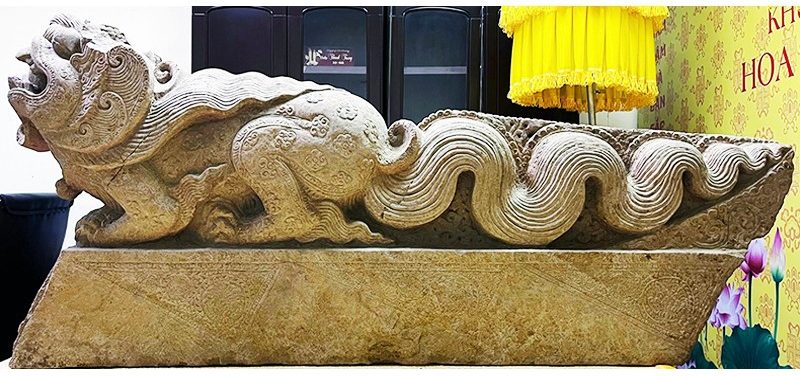
Photo: Stone crocodile sculpture forming a Ly dynasty stepped terrace at Hoa Lam Vien, currently preserved at Phuc Lam Pagoda, Dong Anh, Hanoi. Credit: Assoc. Prof. Dang Hong Son.
From fragments of memory
The homeland of the Ly dynasty originated in the former Dong Ngan cultural region, corresponding to present-day Dong Anh. Professor Nguyen Quang Ngoc, vice president of the Viet Nam Historical Science Association, has stated that, based on available evidence, it is now possible to identify the homeland of the Ly dynasty as Dien Uan commune of Co Phap, located at the confluence of the Thien Duc River, the ancient Duong River, and the former Tieu Tuong River. This area corresponds to present-day Dinh Bang and Duong Loi villages, now part of Tu Son ward in Bac Ninh province.
Hoa Lam, the maternal homeland of the Ly dynasty, emerged at an early stage. Archaeological findings confirm that it was an important settlement site during the pre-Thang Long period of the ninth to tenth centuries, as evidenced by Jiangxi Army bricks and high-grade glazed ceramics. When Ly Thai To relocated the capital from Hoa Lu to Thang Long, Hoa Lam was selected for the construction of Hoa Lam Vien as a royal retreat, contemporaneous with the building of the Imperial Citadel of Thang Long. The spatial extent of Hoa Lam Vien encompassed the entire area north of the Thien Duc River, now the Duong River. Over time, Hoa Lam Vien became the most important royal retreat of the Ly dynasty after the Imperial Citadel of Thang Long.
Assoc. Prof. Dang Hong Son, vice rector of the University of Social Sciences and Humanities in Hanoi, stated: “The Department of Archaeology within the Faculty of History has conducted three excavation campaigns, in 1993, 2002 and 2005, which brought to light a number of significant artefacts. Among the most important discoveries were two triple-stepped terraces formed as stone representations of mythical crocodile figures. These stone crocodile figures were carved with a high degree of refinement in sandstone, reflecting both the stylistic characteristics and the highest artistic standards of Ly dynasty sculpture”.
Assoc. Prof. Tong Trung Tin, president of the Viet Nam Association of Archaeology and the scholar who directed the excavations at the Imperial Citadel of Thang Long, in his study of the two stone terrace balustrades carved with mythical crocodile figures discovered in the Hoa Lam Vien area, affirmed: “These are the finest Ly dynasty mythical crocodile artefacts known to us to date. Such important objects are found only within architectural complexes of substantial scale constructed according to courtly architectural principles. These stone balustrades share characteristics similar to those of Ly dynasty stone crocodile balustrades discovered at the Imperial Citadel of Thang Long, indicating that they were architectural components of constructions of state-level significance”.
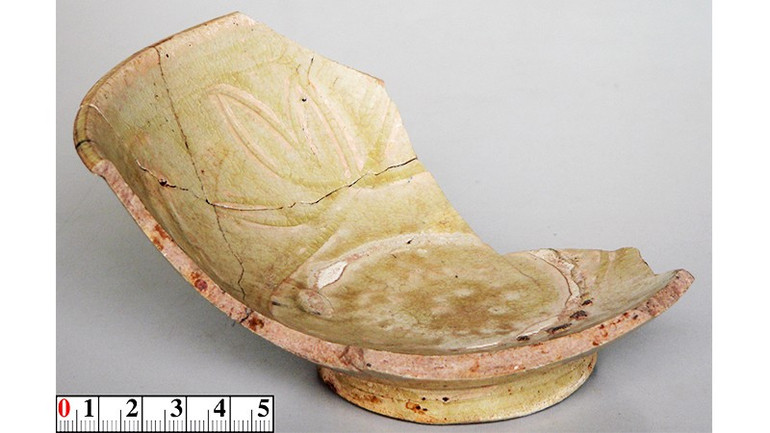
Photo: Ly dynasty glazed ceramic artefacts from the Hoa Lam Vien site.
Towards a cultural industry focal point in northern Thang Long
Present-day Dong Anh contains a dense concentration of cultural resources, with thirty-eight registered historical and cultural sites linked to the Co Loa complex, forming a heritage zone with considerable potential for the development of cultural industries. The Hoa Lam Vien site is being oriented towards the activation of a living historical and cultural heritage space associated with the Ly dynasty, in which past values are interpreted, reconstructed and connected with contemporary life. Architect Dinh Viet Phuong, director of 3D Art Company, has suggested that “the core values of heritage can be re-created through virtual environments and digital technologies, enabling the public to experience heritage values by linking virtual space with the sacred cultural spaces of representative heritage sites”.
Cultural industries, although emerging from archaeological remains and ruins, can contribute to the revitalisation of heritage through a range of possible developments, including spiritual tourism, digital museums integrating advanced technologies such as virtual reality, augmented reality and mapping, educational experiences such as participatory archaeology programmes, and experiential models combining sustainable agriculture with court cuisine traditions, such as Hoa Lam yen (a court banquet tradition). With its distinctive cultural resources, Hoa Lam Vien offers Dong Anh the opportunity to build a destination identity and develop a heritage-based economy grounded in the site’s multiple cultural values.
Promoting Hoa Lam Vien through a model of heritage economy development based on cultural industries and sustainable tourism would allow historical and cultural values to be transformed into a range of experiential pathways and distinctive cultural products, including regional culinary products, handicrafts and locally rooted souvenirs. Such an approach has the potential to generate livelihoods and added value for local communities.
From Hoa Lam Vien, a new approach to heritage conservation and value promotion can be envisaged, based on the balanced integration of sustainable conservation, cultural creativity, digital transformation and active community participation. This approach contributes to addressing the relationship between conservation and development, enabling heritage to serve as a foundation for contemporary growth. However, the development of cultural industries associated with Hoa Lam Vien requires a multi-stakeholder approach, involving local authorities, scholars, local communities and the private economic sector.
Ngu Thien (https://nhandan.vn/)