
Reconstructing Kinh Thien Palace: Authenticity in the World Heritage Context
At the recent Asia-Pacific Dialogue on Heritage and Authenticity in Hanoi, Nguyen Thanh Quang, Director of the Thang Long–Hanoi Heritage Conservation Centre, presented a groundbreaking approach with both theoretical and practical implications in his paper, Reconceptualising Authenticity: How the Study of Kinh Thien Palace Advances the Categorisation of Authenticity in World Heritage Practice.
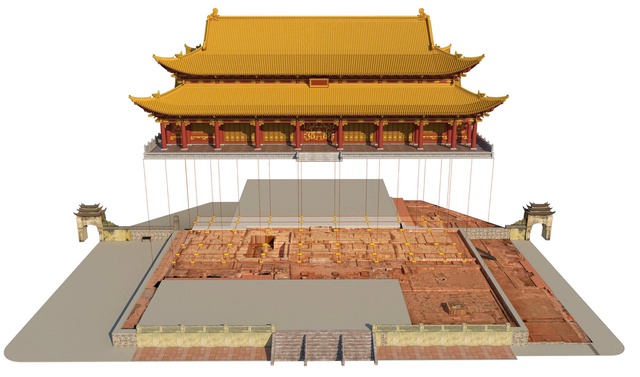
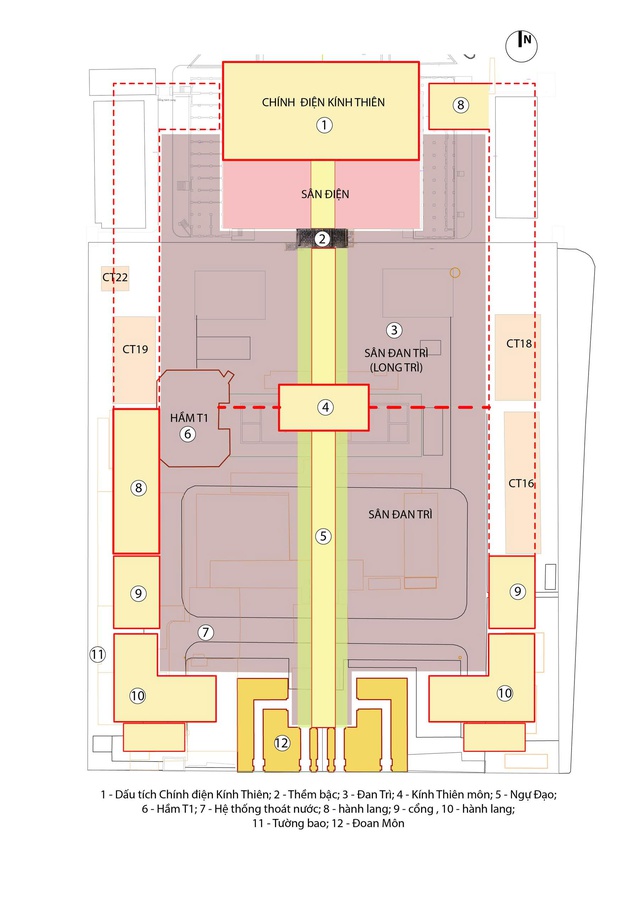
Diagram showing the relationship between archaeological remains and the reconstructed architecture. Image: Thang Long–Hanoi Heritage Conservation Centre
The reconstruction of Kinh Thien Palace is not only a deeply held aspiration shared by communities and generations of scholars, but also a central pillar of the “Vision for the Central Axis of the Thang Long Imperial Citadel, 2025–2030”. This important vision was formally endorsed through Decision 48 COM 7B.25, adopted by the World Heritage Committee at its 48th session in Busan, Republic of Korea.
In this historic decision, the World Heritage Committee particularly commended Vietnam’s systematic efforts to consolidate historical knowledge and develop a methodology for assessing the reliability of documentary sources. However, following in-depth analysis, the World Heritage Centre (WHC) and the International Council on Monuments and Sites (ICOMOS) set a more exacting requirement: further clarification of the reliability of the documentation and the methods used to authenticate individual architectural components, ensuring that all design proposals can be clearly identified, compared and verified through a transparent process.
Archaeological Layers and the Reconstructed Building: Defining the Boundaries of Outstanding Universal Value
One of the most significant theoretical contributions highlighted by Nguyen Thanh Quang and his research team is the need to correctly identify the nature of the attributes that convey the Outstanding Universal Value (OUV) of the Imperial Citadel of Thang Long World Heritage property. This is essential to safeguarding its integrity before considering reconstruction as a means of presenting and enhancing the heritage..
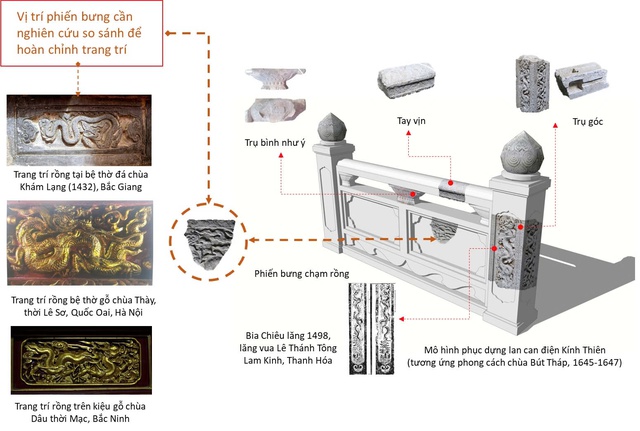
Reconstruction of the Kinh Thien Palace platform balustrade based on authenticated and verified evidence and comparative analysis. Image: Thang Long–Hanoi Heritage Conservation Centre
According to the Centre’s Director, the foremost consideration in the reconstruction dossier for Kinh Thien Palace is the approach to conserving and presenting the archaeological remains and cultural layers that bear witness to more than 1,300 years of continuous history. These are the original attributes that underpin the property’s OUV and must be preserved intact in situ.
By contrast, the above-ground reconstruction of the Le-dynasty Kinh Thien Palace is not considered an original attribute conveying OUV, but is defined solely as an “interpretive tool”. Its role is to make the property’s heritage attributes visible and intelligible to the public and future generations. More importantly, the reconstructed palace will revive intangible heritage values and provide a shared heritage space where people can practise their beliefs and fulfil their spiritual needs, thereby revitalising and sustaining living heritage.
Drawing a clear distinction between “attributes conveying OUV that require in situ conservation”—the archaeological layers—and an “interpretive tool”—the reconstructed building—is decisive. This distinction fully addresses ICOMOS’s concern that the project might inadvertently elevate the reconstructed building to the status of an original, authentic element of the property, or obscure the values embodied in its historical depth, continuity and succession. It also establishes a sound theoretical foundation for planning and conservation at the site.
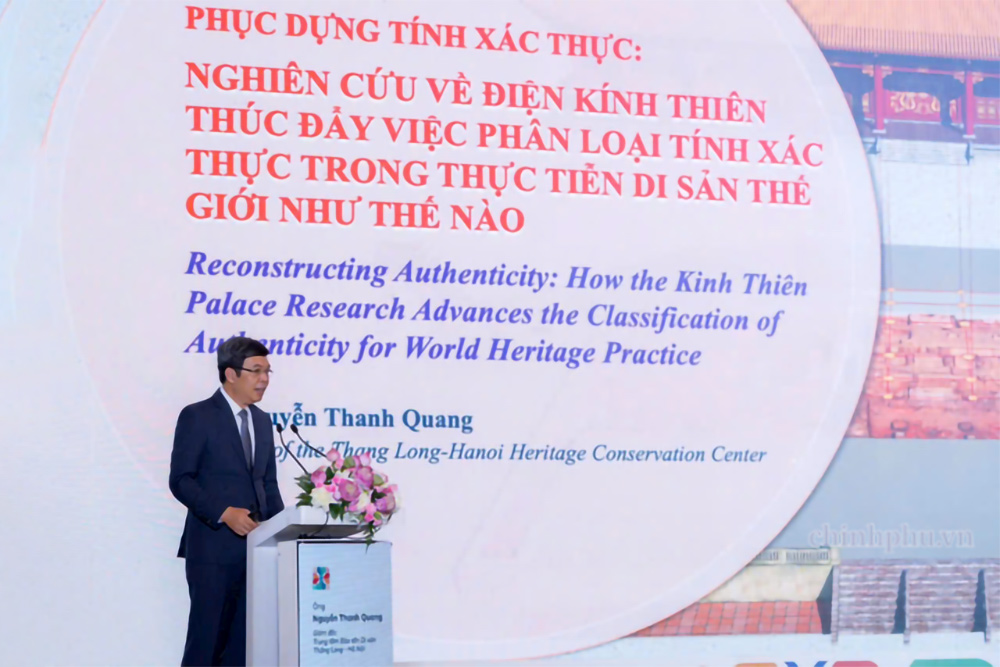
Nguyen Thanh Quang, Director of the Thang Long–Hanoi Heritage Conservation Centre, presents his paper at the Asia-Pacific Dialogue on Heritage and Authenticity. Photo: Chinhphu.vn
The 5+1 Colour-Coding Toolkit: Putting Authenticity Assessment into Practice
To address the challenge of establishing authenticity for a timber building completely destroyed in the past, the Thang Long–Hanoi Heritage Conservation Centre has developed a toolkit for collecting information and assessing the reliability of its sources, functioning as an interdisciplinary assessment framework.
Presented as a series of tables using an intuitive colour-coding system, the toolkit integrates five core categories of evidence: historical documentation, including written records, official histories and early geographical accounts; archaeological evidence, comprising foundation traces, stone column bases, bricks, tiles and excavated artefacts; visual documentation, including historical drawings, maps and early photographs; domestic comparative evidence drawn from surviving timber buildings in Vietnam that are contemporary with, or share architectural similarities with, the lost structure; and international comparative evidence from East Asian palace architecture associated with historical cultural exchanges.
Drawing on excavations at the Thang Long Imperial Citadel, Nguyen Thanh Quang and the Centre have proposed a particularly important sixth criterion: the “intrinsic value of archaeological artefacts”. This criterion draws directly on information embedded in the artefacts themselves, including manufacturing techniques, material traces, their period of use and evidence of their makers.
Artefacts contain valuable information that no indirect source can provide. To illustrate this, the author cited a brick discovered at the Kinh Thien Palace foundations, dating to 1466 during the reign of Emperor Le Thanh Tong and bearing the inscription “Dai doi truong (thap) ngu quan, Ngoc Kiem ve Phe Cang quan”. The inscription points to the Eastern Military Command of Dong Dao (Hai Duong and An Bang). It sheds light on how the state mobilised military units and skilled craft villages to build the palaces of Thang Long during the Early Le dynasty.
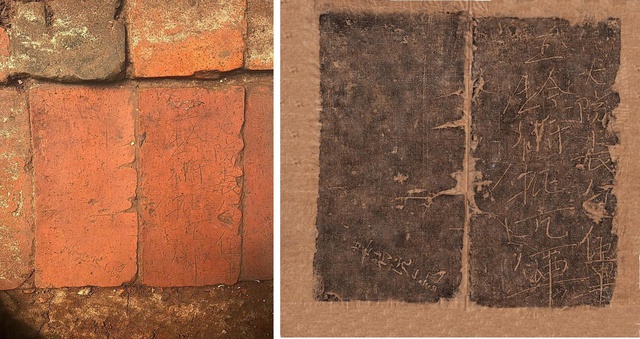
A brick bearing the inscription “Dai doi truong (thap) ngu quan, Ngoc Kiem ve Phe Cang quan”, dating to 1466 during Emperor Le Thanh Tong’s reign, found at the Kinh Thien Palace foundations. The inscription refers to the Eastern Military Command of Dong Dao (Hai Duong and An Bang, corresponding to the present-day Hai Phong area). Photo: Thang Long–Hanoi Heritage Conservation Centre
The research team divided the proposed reconstruction of Kinh Thien Palace into 50 architectural components and details across three principal sections: the foundations, the main structure and the roof. The toolkit was then used to assess and verify the evidence for each component before translating the findings into architectural drawings.
Once the reliability of the evidence for each detail has been assessed, the colour codes record the findings, which are then aggregated to produce a quantitative assessment. Elements supported by strong evidence can be established with confidence, while those with less substantial documentation undergo further comparison with contemporary structures to determine an appropriate form for the proposed design.
At this stage, experts from the World Heritage Centre and ICOMOS recommend giving priority to the option that best conveys the property’s historical depth, continuity and succession, as these form part of its OUV.
The resulting architectural proposal for the reconstruction of Kinh Thien Palace thus goes beyond qualitative conjecture: its evidential basis has been quantified, verified and made fully transparent throughout the architectural drawings.
The southern stairway has been raised and its central passage narrowed to suit Long Thien Palace, in accordance with Nguyen-dynasty regulations for imperial residences used during royal visits. Photo: Thang Long–Hanoi Heritage Conservation Centre
Expert Review: Refining the Methodology to Meet ICOMOS Standards
Heritage experts regarded the Thang Long–Hanoi Heritage Conservation Centre’s colour-coding toolkit as the most concrete and impressive contribution to putting theory into practice across the heritage dialogue programme. The method translates abstract theoretical concepts of “authenticity” into an assessment tool that can be applied directly to architectural drawings.
However, to make the reconstruction dossier as robust as possible in responding to ICOMOS’s evaluation, expert reviewers identified several key areas requiring further refinement:
Defining the limits of comparison: The scope and limitations of the “domestic comparative evidence” category must be clearly stated. Architectural comparisons between Hue and Thang Long, for example, require particular caution, as the two former capitals have entirely different historical trajectories, political contexts and foundations for their OUV.
Demonstrating a precautionary approach: The toolkit must demonstrate its ability to support a decision that reconstruction “should not yet proceed” when evidence is insufficient, as well as substantiate a selected design proposal. Kinh Thien Gate provides a clear example: where historical and archaeological evidence had not reached the necessary level of reliability, a precautionary approach was taken by putting the reconstruction proposal on hold.
Establishing authenticity thresholds and provisions for dismantling: The minimum authenticity score required to justify reconstruction must be clarified. Where essential architectural components are supported by limited evidence, the design should remain flexible, allowing them to be dismantled or modified if future excavations yield new evidence.
The Kinh Thien Palace study demonstrates that assessing authenticity in reconstruction must begin with the values, attributes and evidence specific to each heritage property. The toolkit developed at the Thang Long Imperial Citadel is therefore intended primarily to identify, classify and verify the reliability of the evidence informing the reconstruction of Kinh Thien Palace, rather than to provide a template for direct application elsewhere. The research also defines the reconstructed building as an interpretive tool, while identifying the archaeological remains and cultural layers, with their historical depth, as the attributes conveying OUV that must take priority in conservation.
The value of this approach lies in placing evidence at the centre of decision-making. Each architectural component is assessed against multiple sources, its evidential reliability evaluated and the findings transparently represented in the proposed design. Elements supported by weaker evidence remain subject to comparative analysis and appropriate treatment, instead of being automatically accepted as authenticated.
By assessing 50 components and details across the foundations, main structure and roof of Kinh Thien Palace, the method enables the degree of authenticity of the proposal to be identified, quantified and verified.
Drawing on the Kinh Thien experience, Vietnam can contribute a specific reference case to the Hanoi Document on how to approach authenticity when reconstructing lost architecture: developing an assessment method suited to the particular values and evidence of each property, rather than seeking a universal formula for all heritage sites. In this way, the experience of the Thang Long Imperial Citadel can be further tested in other heritage contexts, adding practical evidence to the international dialogue on authenticity and heritage reconstruction.
Minh Anh