
Hanoi Flag Tower – A Historic Symbol of the Capital
Hanoi Flag Tower – A Witness to More Than Two Centuries of History
Standing in the heart of Hanoi, the Hanoi Flag Tower rises proudly as a symbol of patriotism, resilience and the enduring aspiration for national independence. More than a remarkable military structure of the Nguyễn Dynasty, the Flag Tower has witnessed many important chapters in the history of Thăng Long–Hanoi, from the imperial era and French colonial period to the Liberation of Hanoi and the development of the modern capital.
Today, the Hanoi Flag Tower is one of the best-preserved and most prominent historic structures within the Central Sector of the Imperial Citadel of Thăng Long – Hanoi, a UNESCO World Heritage Site inscribed in 2010. It is also an important destination for visitors exploring the history and heritage of Thăng Long.
A Strategic Location within the Imperial Citadel of Thăng Long
The Hanoi Flag Tower is located on Điện Biên Phủ Street, Ba Đình District, Hanoi. The structure was built in 1812, during the reign of Emperor Gia Long, on the southern side of the former Imperial Citadel of Thăng Long.
According to the historical layout of the citadel, the Flag Tower marks the southern end of the central axis, also known as the ceremonial axis, which runs through the heart of the Imperial Citadel. From the Flag Tower, this axis extends through Đoan Môn and continues to Kính Thiên Palace, the central and most important site of the former imperial court. Its strategic position demonstrates that the Flag Tower was not merely a military structure but also an important component of the overall architectural and spatial organization of the imperial citadel.
The History of Hanoi Flag Tower
After the Nguyễn Dynasty unified Vietnam and established its capital at Phú Xuân (Huế), Emperor Gia Long ordered the reconstruction of the Hanoi Citadel. The Hanoi Flag Tower was built in 1812 as part of the citadel’s military infrastructure, serving purposes related to observation, communication and signaling.
The tower was constructed on an area that had previously formed part of the Tam Môn, or Three-Gate structure, on the southern side of the Imperial Citadel during the Lê period. The Flag Tower was used to display the imperial flag and communicate important signals across the citadel.
One of the most remarkable aspects of its history is that, while many structures of the Hanoi Citadel were demolished in the late 19th century, the Hanoi Flag Tower was among the very few major structures to survive almost intact. It therefore remains an exceptionally valuable historical monument of Thăng Long–Hanoi.
The Unique Architecture of Hanoi Flag Tower
The Hanoi Flag Tower is one of the finest surviving examples of early 19th-century military architecture in Vietnam.
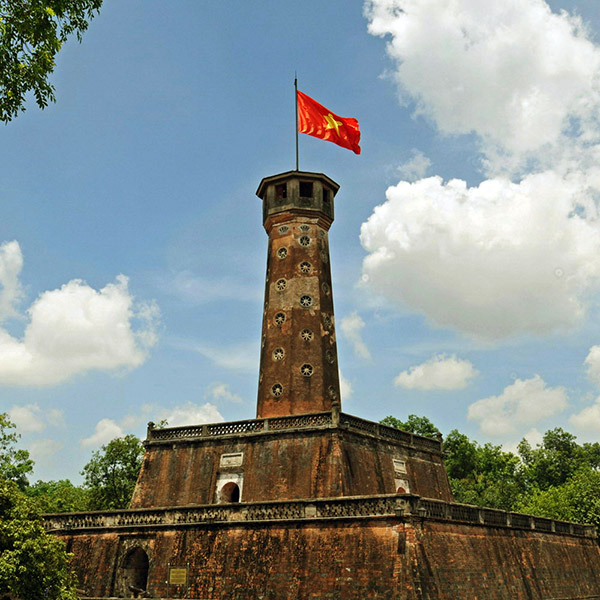
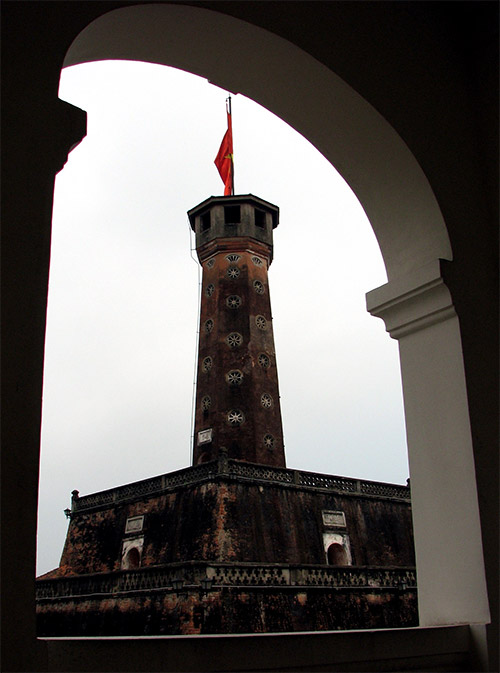
The structure consists of three square-tiered platforms, a tall octagonal tower and an octagonal pavilion at the top. The main structure is approximately 33.4 meters high, while the total height reaches about 41.4 meters, including the flagpole.
The Three Platforms
The three platforms are built in the form of truncated square pyramids, each tier becoming progressively smaller toward the top.
- First tier: approximately 42.5 meters on each side and 3.1 meters high, with two brick stairways leading upward.
- Second tier: approximately 27 meters on each side and 3.7 meters high, with four entrances facing the four cardinal directions.
Three of these entrances bear Chinese inscriptions with auspicious meanings:
- Nghênh Húc on the eastern side – “Welcoming the morning sunlight.”
- Hồi Quang on the western side – “Reflected light.”
- Hướng Minh on the southern side – “Facing the light.”
The northern entrance bears no inscription.
- Third tier: approximately 12.8 meters on each side and 5.1 meters high, providing access to the tower above.
The Tower and Octagonal Pavilion
Rising from the third platform is the main tower, an 18.2-meter-high octagonal structure that gradually tapers toward the top. Inside the tower is a spiral staircase with 54 steps, leading to the upper pavilion. One of the tower’s most distinctive architectural features is its system of 39 fan-shaped openings. These openings provide both natural light and ventilation, allowing air to circulate throughout the tower. At the top is an octagonal pavilion approximately 3.3 meters high, with eight windows corresponding to its eight sides. At the center of the pavilion is a cylindrical structure that supports the flagpole. The flagpole itself is approximately 8 meters high. Together, these architectural elements create the distinctive silhouette that has become one of the most recognizable landmarks of Hanoi.
Remarkable Traditional Building Techniques
One of the fascinating features of the Hanoi Flag Tower is the comfortable interior climate despite Hanoi’s hot summers. The design of the tower incorporates a sophisticated system of openings and ventilation passages that allows air to circulate naturally. The thick brick walls also help regulate the temperature inside the structure.
The stairways, entrances and drainage system were carefully designed so that rainwater would not easily enter the interior of the tower. These features demonstrate the advanced construction knowledge and craftsmanship of Vietnamese builders in the early 19th century.
Hanoi Flag Tower Through Historical Turmoil
During the French colonial period, the Hanoi Flag Tower was used as a military observation post because of its elevated position. Historical photographs from the late 19th century show French troops establishing military facilities around the tower and using it as an important lookout point. During the Vietnam War, the Flag Tower once again served as an observation post for Hanoi’s air-defense forces. From the top of the tower, soldiers could observe a vast area of Hanoi and its surrounding districts. Despite wars and major changes to the urban landscape, the Flag Tower continued to stand, becoming a powerful symbol of the resilience of Hanoi.
The Historic Flag-Raising Ceremony of October 10, 1954
One of the most important historical events associated with the Hanoi Flag Tower took place on October 10, 1954, when Hanoi was officially liberated. At exactly 3:00 p.m., the siren of the Hanoi Opera House sounded for a long time. The military band performed the National Anthem under the direction of musician Đinh Ngọc Liên, while the red national flag with a yellow star was slowly raised to the top of the Hanoi Flag Tower. It was the first time that the national flag of the Democratic Republic of Vietnam flew over the tower following the liberation of Hanoi. That historic moment became one of the enduring symbols of peace, independence and the return of Hanoi to national sovereignty. Since then, the national flag has continued to fly proudly above the tower, becoming an iconic image deeply associated with the capital.
A Symbol of Hanoi and Vietnam
Soon after the establishment of the Democratic Republic of Vietnam, an image of the Hanoi Flag Tower was prominently featured on the country’s first banknotes issued by the National Bank of Vietnam.
This reflects the special symbolic significance of the monument in modern Vietnamese history. Today, a large red flag with a yellow five-pointed star flies above the tower, standing out against the Hanoi skyline as a powerful symbol of national independence, sovereignty and pride.
A Must-See Destination in the Imperial Citadel of Thăng Long
Today, the Hanoi Flag Tower is located on the grounds of the Vietnam Military History Museum and forms part of the broader heritage landscape of the Imperial Citadel of Thăng Long. From the Flag Tower, visitors can continue their exploration of several important historic sites, including:
- Đoan Môn (Doan Mon Gate)
- Kính Thiên Palace
- Hậu Lâu (Princess’s Palace)
- Archaeological Site at 18 Hoàng Diệu
- Bắc Môn (Northern Gate)
Together, these monuments help visitors understand the remarkable history of Thăng Long–Hanoi and the evolution of the political and cultural center of Vietnam over more than a thousand years.
Historical and Cultural Significance
After more than two centuries, the Hanoi Flag Tower remains not only an outstanding example of military architecture but also a powerful symbol of the capital. From the imperial flags of the Nguyễn Dynasty to the red national flag raised on October 10, 1954, and the flag that continues to fly today, the tower has been closely connected with important milestones in Vietnamese history.
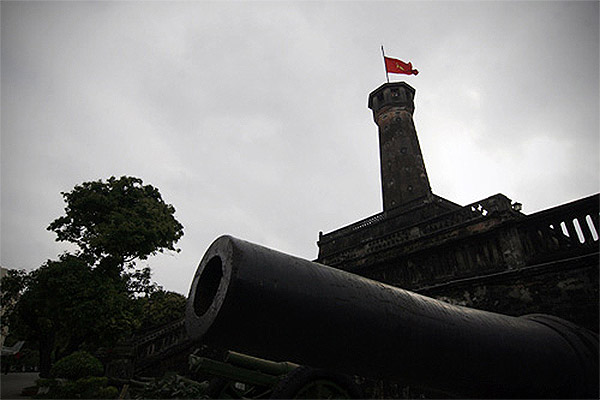
Standing amid modern Hanoi, the Flag Tower remains a timeless witness to the nation’s struggles for independence and sovereignty. Together with the surviving monuments and archaeological remains of the Imperial Citadel, it contributes to the outstanding universal value of the Imperial Citadel of Thăng Long – Hanoi, a UNESCO World Heritage Site.
NTT