Scientific symposium “Hoa Lam Vien, a Ly dynasty royal Retreat”
On 13 January 2026, at the Hoa Lam Vien site, a Ly dynasty royal retreat located in present-day Dong Anh district, Hanoi, the University of Social Sciences and Humanities, Viet Nam National University Hanoi, the Hanoi Historical Science Association, and the Hoa Lam Vien Site Management Board jointly organised the scientific symposium “Hoa Lam Vien, a Ly dynasty royal Retreat: Heritage values and directions for cultural industry development in the present context”.
The symposium took place as the country moves towards the 14th National Congress of the Communist Party of Viet Nam and responded to the growing need to identify, safeguard and promote cultural heritage values in relation to sustainable development, particularly the development of cultural industries in the capital city of Hanoi.
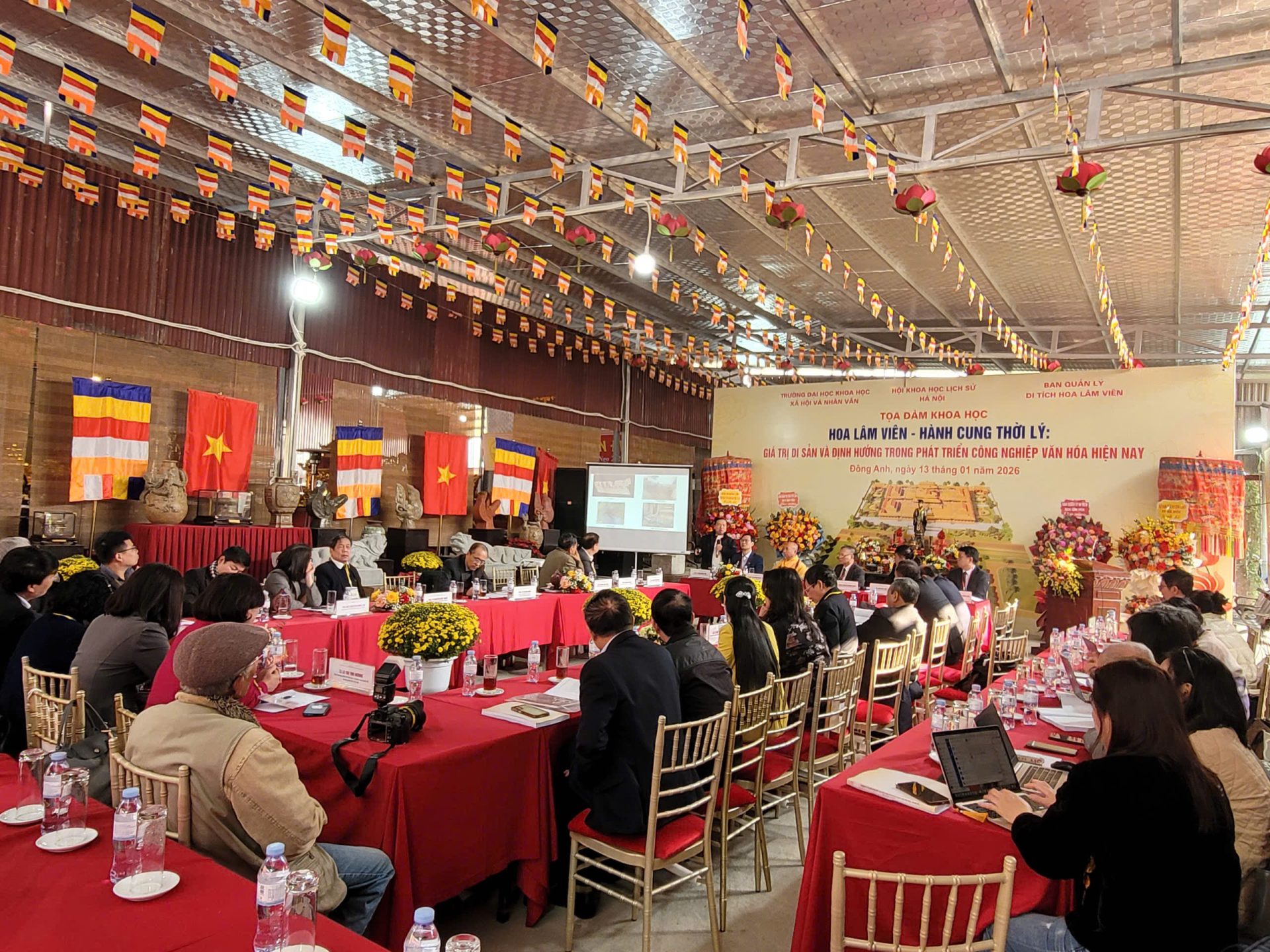
Photo: The venue of the scientific symposium “Hoa Lam Vien, a Ly dynasty royal Retreat: Heritage values and directions for cultural industry development in the present context”
Hoa Lam Vien, a royal retreat of the Ly dynasty
In his opening remarks, Dr Nguyen Van Son, president of the Hanoi Historical Science Association, emphasised that Hoa Lam Vien was not only a representative royal retreat of the Ly dynasty but also a space closely associated with the homeland and origins of the Ly royal house. As such, the site occupies a position of particular importance in the history of the formation and development of the Dai Viet state.
With heritage values and contemporary development orientations as its central focus, the symposium sought to clarify in a comprehensive manner issues relating to the spatial organisation of Hoa Lam Vien as a Ly dynasty royal retreat, its connections with Co Loa, the Imperial Citadel of Thang Long and the Red River cultural axis, as well as the capacity of this heritage site to participate directly in processes of socio-economic development and cultural industry development in the capital.
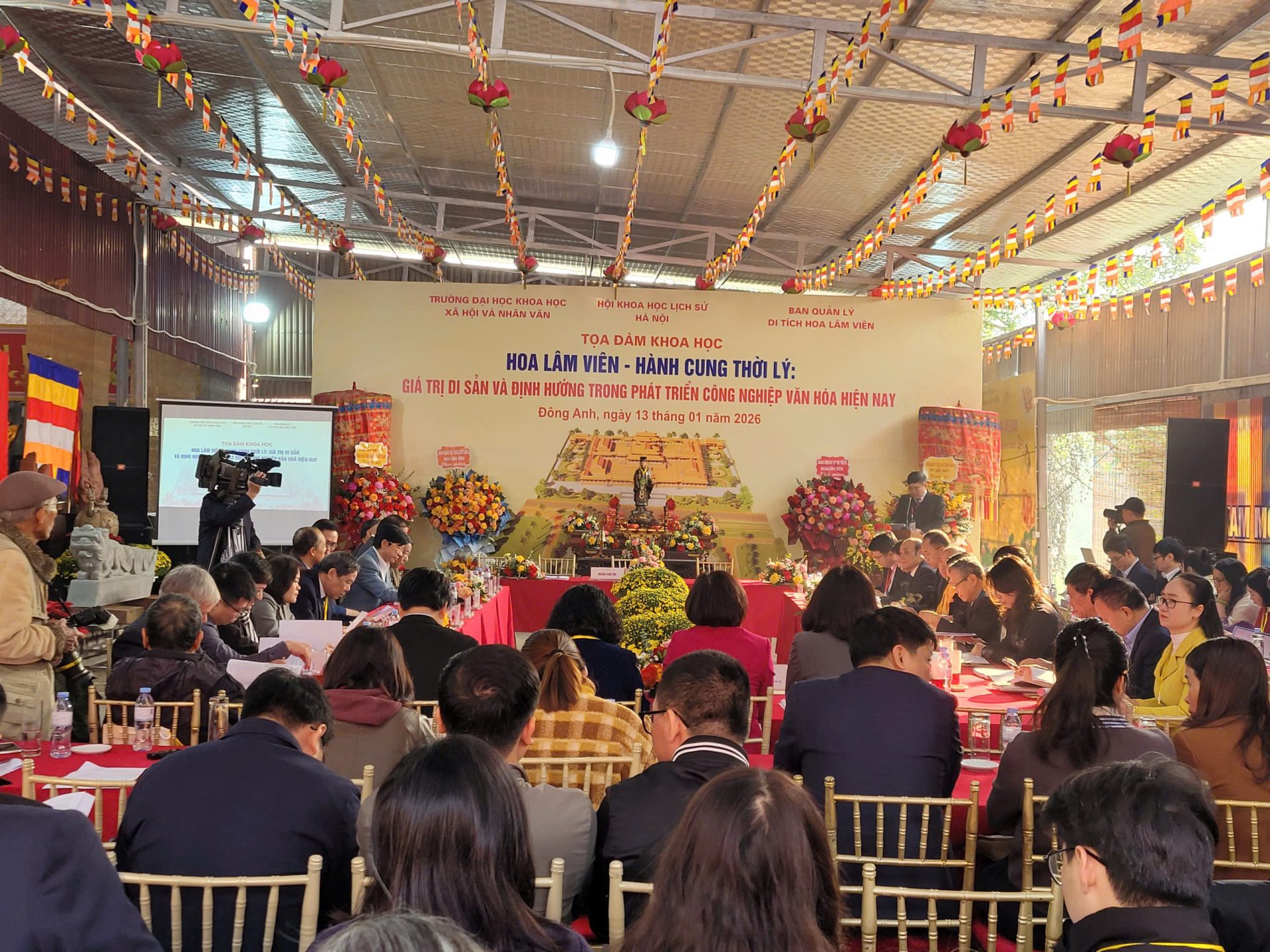
Photo: Dr Nguyen Van Son, president of the Hanoi Historical Science Association, delivering the opening address
Distinctive historical, cultural and ideological values
According to the organising committee, the symposium received twenty-two papers from scholars representing a wide range of disciplines, including history, archaeology, geography, architecture, Han Nom studies, cultural heritage studies and cultural management.
The papers were grouped into three main thematic clusters. Particular emphasis was placed on the cluster addressing the promotion of the heritage values of the Hoa Lam Vien royal retreat within the cultural space north of the Red River, in close relation to practical issues of heritage management, conservation and the utilisation of heritage values.
Scholars noted that Hoa Lam Vien should not be understood merely as a court architectural complex, but also as a space for ancestral worship of the Ly dynasty. It reflects political and ethical concepts characteristic of the Ly period, in which Buddhism was combined with indigenous traditions of filial piety to establish and reinforce the legitimacy of royal authority.
Several studies further clarified the broader geo-cultural context of Hoa Lam Vien, situating the site within the heritage network of Dong Anh and the area north of the Red River. The site was shown to have close connections with the Co Loa site, the Imperial Citadel of Thang Long, and ancient transportation and cultural routes, particularly the Thien Duc River, now known as the Duong River.
Linking Co Loa and Hoa Lam Vien in cultural tourism development
A number of papers focused on the potential for linking Hoa Lam Vien with the Co Loa site in order to form an integrated heritage space, contributing to the development of a distinctive model of cultural and historical tourism in the Dong Anh area.
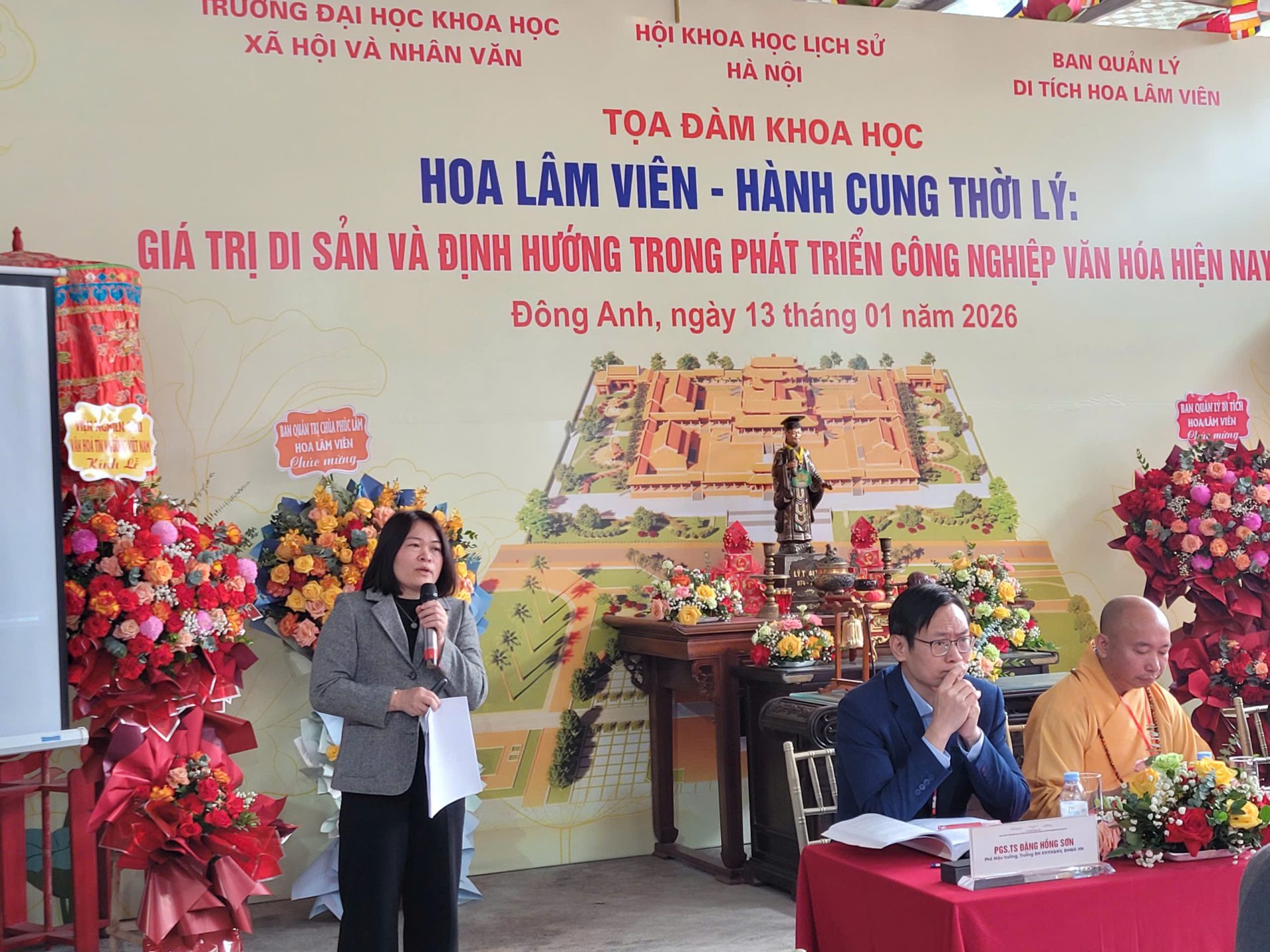
Photo: MA doctoral candidate Nguyen Hong Chi, deputy director of the Thang Long – Hanoi Heritage Conservation Centre, presenting a paper on orientations and solutions for promoting the heritage values of the Hoa Lam Vien royal Retreat and the Co Loa citadel
According to participating scholars, Co Loa, an early centre of power of the Au Lac state, and Hoa Lam Vien, a royal retreat associated with the homeland of the Ly dynasty, belong to different historical periods but display continuity in spatial organisation, historical development and cultural memory. Linking these two sites would not only enhance the overall value of each heritage place but also create conditions for the development of thematic tourism routes such as:
- From Co Loa to Hoa Lam Vien, a journey through ancient centres of power
- The cultural space north of the Red River across successive dynasties
Through such linked routes and destinations, visitors would be able to engage with history in a more systematic manner, from the early period of state formation to the era of an independent Dai Viet state, while also extending their experience to heritage education activities, archaeological visits, local cultural engagement and cultural industry products.
The symposium reached a shared view that the promotion of the heritage values of Hoa Lam Vien should be embedded within an overall strategy for cultural and tourism development in the Dong Anh area, in which linkage with the Co Loa site plays a central role.
Hoa Lam Vien was identified as a focal point for connecting the historical memory of the Ly dynasty, while Co Loa represents the core historical and cultural space of the early state formation period. Their integration would provide a foundation for the development of culturally substantive tourism products, avoiding fragmentation and duplication and moving towards sustainable development. The application of digital technologies, the creation of experiential spaces, heritage interpretation, the integration of tour routes, together with the active participation of local communities, were identified as key measures for transforming heritage values into development resources, contributing to the cultural industries and to the socio-economic development of the capital city of Hanoi.
Drawing on the diverse and multi-dimensional body of papers presented, the scientific symposium not only clarified the historical and cultural values of the site but also opened new approaches to heritage conservation, value promotion and heritage linkage, particularly with regard to the relationship between Hoa Lam Vien, Co Loa and Thang Long within strategies for cultural development, tourism and cultural industries in the capital.
Co Loa Site Management Board